

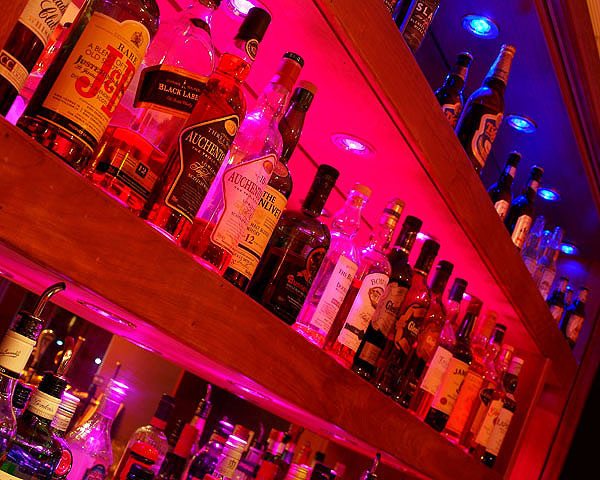
We are now in an exciting period in relation to LED technology for both residential and commercial assignments to create multifunctional spaces, mood and emotional states within those spaces. The advancements in LED technology have now enabled lighting designers to control and alter the dispositions evoked and experienced by people within a space to a level that was not attainable with past, more traditional forms of lighting. Designers are able to achieve these schemes using LED’s that still emit a desirable amount of light.
Recent advancements in LED technology now mean they can be used freely within both domestic and commercial settings. Crucially, efficiency is central to creating a lighting solution in any space, and LED has now developed such that it is able to combine that ideal fusion of efficiencym and mood setting. Although the LED market is not heavily regulated, two voluntary standards monitor their efficiency and therefore usability: LM80 and LM70. These deal with lumen maintenance (and life) and how that performance is in turn measured over life, respectively. Manufacture and consequent lamp performance is therefore something that whilst officially unregulated, has some semblance of control and expectation in the industry.
Typically, LED lamps operate under lower temperature than traditional filament and tungsten fittings, which are rapidly decreasing in popularity. If the temperature rises in an LED fitting, the chip will eventually fail, and usually, the internal mechanism of the lamp will operate at no more than 25 degrees. Poor efficiency means filament and tungsten fittings are steadily being banned across much of the European Union, and it stands to reason that with technological progression in terms of LED construction and performance, LEDs are set to eventually replace the vast majority of these. In my opinion, the current popularity of LED instalments
means this ban, or indeed, replacement operation, is not particularly far off
in its entirety.
From a design aspect, space purposes differ – not just from one another, but actually within themselves. A single space may serve many purposes. Therefore, when designing lighting requirements, there is an obligation for the designer to strongly consider the concept of ‘mood’ as a fundamental issue. Advancements in RGB technology mean designs can now introduce colour change and mood lighting to create a multifunctional space for
use at different times of the day and different purposes. High quality LEDs are capable of achieving CRI of 85-95 in fourteen varying colours, making them a highly desirable choice for aesthetically pleasing and efficient installations. We can now also dim LED’s to various criteria, enabling seamless integration with lighting control to meet the end brief for the lighting effects our clients may wish to achieve in one space.
The fact that sought after warmth in colour temperature from LED has now been reached is revolutionary in lighting design. This, in the past, was not especially possible using LED lighting solutions, with the colour temperature erring on the side of being far too cold. Whilst cool lighting in certain situations may feel appropriate, a warm, inviting mood evoked by a lighting instalment is often preferable.
The difference now between a warm LED lamp and a traditional MR16 lamp is minimal. On an interesting note, a member of our staff attended a training course recently with one of our suppliers, and the group of professional lighting designers present actually identified an LED lighting effect as being halogen. Therefore, by way of using the right products, warm
LED temperatures can absolutely be attained, and the proof is clearly out there. In effect, LED technology can now be considered completely capable of providing a desirable and interchangeable ambiance.
In a practical sense, LED technology has become a viable and often preferable option for both domestic and commercial consumers. With low cost and low energy benefits, LED
technology satisfies the parameters of financial control and environmental awareness. With costs having now considerably come down with the advancement of LEDs, and the wide variety of products on the market, this technology is now especially affordable to the end client who may well be working to a budget.
With LED light outputs now achieving or even surpassing halogen equivalents, however the information regarding the output of an LED still leaves people confused. This is actuallyvery easy to understand as the wattage of an LED lamp does not equate to the light output of that same lamp. The performance is based on a number of factors which include the quality of its components, such as the LED chip, and how effectively the LED can dissipate heat. At the present time there is no regulatory ontrol over this. As a basic guide using the lumens per watt can give a good indication as to the efficiency of the lamp.
The extensive lifespan of LED lamps is also a very desirable aspect in choosing to utilize it in a lighting design scheme. Some manufacturers even claim up to 100,000 hours of use before lamps will need changing. Whilst concrete studies to support this claim have not yet been presented, it is generally accepted that LED technology is now such that lamps will last a number of years before requiring replacement, and this ease of maintenance is an attractive prospect for any consumer.
